Cet article présente une liste de primitives usuelles de fonctions exponentielles . Les fonctions dérivées de la fonction exponentielle sont d'une importance capitale en mathématiques et en physique. De ce fait, il est courant de devoir les intégrer. La liste suivante donne quelques primitives de ces fonctions :
Liste
Une constante (la constante d'intégration) peut être ajoutée au côté droit de n'importe laquelle de ces formules ; elle a été supprimée ici par souci de brièveté. Sauf mention contraire, on utilise
a
,
b
,
c
∈
R
{\displaystyle a,b,c\in \mathbb {R} }
Intégrale de l'exponentielle
∫
e
a
x
+
b
d
x
=
1
a
e
a
x
+
b
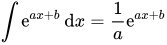
{\displaystyle \int \mathrm {e} ^{ax+b}\,\mathrm {d} x={\frac {1}{a}}\mathrm {e} ^{ax+b}}
a
≠
0
{\displaystyle a\neq 0}
Intégrale du quotient de l'exponentielle sur
x
{\displaystyle x}
∫
e
a
x
x
d
x
=
ln
|
x
|
+
∑
n
=
1
+
∞
(
a
x
)
n
n
!
⋅
n
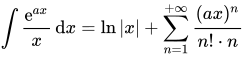
{\displaystyle \int {\frac {\mathrm {e} ^{ax}}{x}}\,\mathrm {d} x=\ln |x|+\sum _{n=1}^{+\infty }{\frac {(ax)^{n}}{n!\cdot n}}}
Intégrale du quotient de l'exponentielle sur une puissance de
x
{\displaystyle x}
∫
e
a
x
x
n
d
x
=
1
n
−
1
(
−
e
a
x
x
n
−
1
+
a
∫
e
a
x
x
n
−
1
d
x
)
{\displaystyle \int {\frac {\mathrm {e} ^{ax}}{x^{n}}}\,\mathrm {d} x={\frac {1}{n-1}}\left(-{\frac {\mathrm {e} ^{ax}}{x^{n-1}}}+a\int {\frac {\mathrm {e} ^{ax}}{x^{n-1}}}dx\right)}
n
∈
R
∖
{
1
}
{\displaystyle n\in \mathbb {R} \setminus \{1\}}
Intégrale du produit de l'exponentielle et d'une puissance de
x
{\displaystyle x}
∫
x
n
e
a
x
d
x
=
1
a
x
n
e
a
x
−
n
a
∫
x
n
−
1
e
a
x
d
x
{\displaystyle \int x^{n}\mathrm {e} ^{ax}\,\mathrm {d} x={\frac {1}{a}}x^{n}\mathrm {e} ^{ax}-{\frac {n}{a}}\int x^{n-1}\mathrm {e} ^{ax}\,\mathrm {d} x}
n
∈
R
∖
{
−
1
}
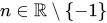
{\displaystyle n\in \mathbb {R} \setminus \{-1\}}
Inverses d'exponentielles
∫
1
1
+
e
a
x
d
x
=
1
a
ln
|
e
a
x
1
+
e
a
x
|
{\displaystyle \int {\frac {1}{1+\mathrm {e} ^{ax}}}\,\mathrm {d} x={\frac {1}{a}}\ln \left|{\frac {\mathrm {e} ^{ax}}{1+\mathrm {e} ^{ax}}}\right|}
a
≠
0
{\displaystyle a\neq 0}
∫
1
b
+
c
e
a
x
d
x
=
x
b
−
1
a
b
ln
|
b
+
c
e
a
x
|
{\displaystyle \int {\frac {1}{b+c\,\mathrm {e} ^{ax}}}\,\mathrm {d} x={\frac {x}{b}}-{\frac {1}{ab}}\ln \left|b+c\,\mathrm {e} ^{ax}\right|}
a
≠
0
,
b
≠
0
,
c
≠
0
{\displaystyle a\neq 0,b\neq 0,c\neq 0}
∫
e
a
x
b
+
c
e
a
x
d
x
=
1
a
c
ln
|
b
+
c
e
a
x
|
{\displaystyle \int {\frac {\mathrm {e} ^{ax}}{b+c\,\mathrm {e} ^{ax}}}\,\mathrm {d} x={\frac {1}{ac}}\ln \left|b+c\,\mathrm {e} ^{ax}\right|}
[ 1]
a
≠
0
,
b
≠
0
,
c
≠
0
{\displaystyle a\neq 0,b\neq 0,c\neq 0}
Intégrale du produit de l'exponentielle et du logarithme népérien
∫
e
a
x
ln
x
d
x
=
1
a
e
a
x
ln
|
x
|
−
1
a
∫
e
a
x
x
d
x
{\displaystyle \int \mathrm {e} ^{ax}\ln x\,\mathrm {d} x={\frac {1}{a}}\mathrm {e} ^{ax}\ln |x|-{\frac {1}{a}}\int {\frac {\mathrm {e} ^{ax}}{x}}\,\mathrm {d} x}
a
≠
0
{\displaystyle a\neq 0}
Intégrale du produit de l'exponentielle et d'un polynôme
Soit
P
{\displaystyle P}
fonction polynomiale . On note
P
′
{\displaystyle P'}
∫
P
(
x
)
e
a
x
d
x
=
1
a
P
(
x
)
e
a
x
−
1
a
∫
P
′
(
x
)
e
a
x
d
x
{\displaystyle \int P(x)\mathrm {e} ^{ax}\,\mathrm {d} x={\frac {1}{a}}P(x)\mathrm {e} ^{ax}-{\frac {1}{a}}\int P^{\prime }(x)\mathrm {e} ^{ax}\,\mathrm {d} x}
a
≠
0
{\displaystyle a\neq 0}
↑ Kurt Gieck , Reiner Gieck et Gaston Bendit , Formulaire technique , Gieck [diff. Dunod], 2007 (ISBN 978-3-379-00026-0 )
Portail de l'analyse














 Portail de l'analyse